Dhori Mata, Bokaro, India
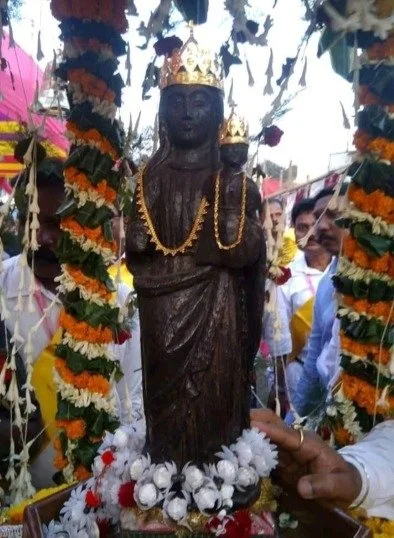
Dhori Mata, Miraculous Mother of the Coal Mines, patroness of the coal miners
In her own church Dhori Mata Tirthalaya, Shrine of Miraculous Mother of the Coal Mines, in Bokaro, 2.2 km North-West of Jarangdih, Jharkhand, (Jarangdih PO, Bokaro Dt, Jharkhand 839 113) dated around 15th century, 45 cm, jackfruit wood.
Although scientists have dated her to around the 15th century, for believers she is acheiropoieta (Greek: ἀχειροποίητα = made without hand), i.e. created by God, just like Our Ladies of Guadalupe and Las Lajas and many other images that appeared miraculously. Indian Buddhists and Hindus call such images self-arising[i] and Dhori Mata is venerated as a heavenly mother by people of all religions in the area.
Dhori is the name of the coal mine where she appeared and Mata means Mother
History
The story of Dhori Mata begins in 1956 in a coal mine worked by miners from the Bilaspuri community in a neighboring state. It was one year after the construction of a giant dam was begun – a dam that would flood their entire cultural heritage. 256 Bilaspuri villages were affected, 36,000 people displaced.[ii] In the midst of this tragedy, the divine Mother, Black Madonna emerged from the darkest place, a coal mine where the desperately poor were brutally exploited.
On Tuesday, June 12, 1956, Rupa Satnami, a Bilaspuri miner at Dhori Coalmine, was excavating coal when he heard a voice say in Hindi: “Strike gently, I am here.” After striking again, he saw a statue inset into a small indentation in the wall of coal. It was a statue of a woman and child, and one of its arms had been broken off by Rupa Satnami’s pickaxe.
The initial reaction among the miners was that this was a statue of the Black Goddess Kali. Kali is very rarely represented with a baby in her arms, but they didn’t know of any other Black goddess.[iii]
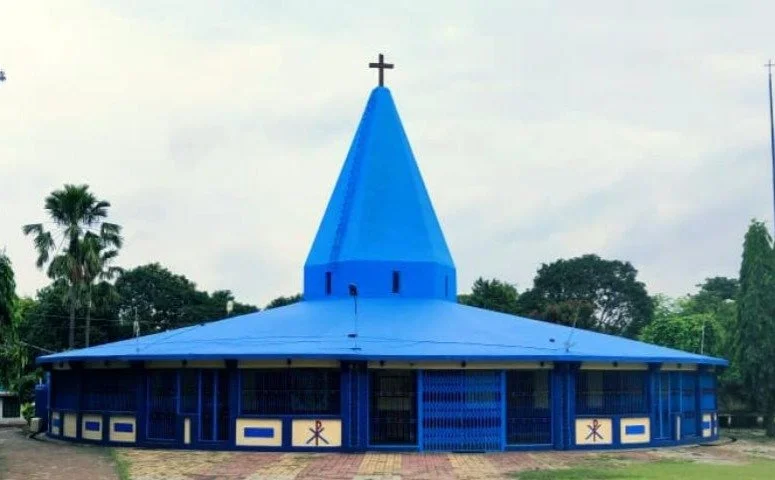
the current Dhori Mata Tirthalaya, Shrine of Miraculous Mother of the Coal Mines
At that time, the local Christian community was small, the fruit of Jesuit missionary work from the mid-19th century onwards. Yet the local priest successfully petitioned to have the statue recognized as the Virgin Mary with Baby Jesus and entrusted to his parish. The Black Madonna was placed in St. Anthony’s church, in Bokaro Thermal a year after its emergence.
She was blessed by Pope Paul VI during his pastoral visit to Mumbai in 1964. In 1967, the statue was sent to Belgium and was found to be made of jackfruit wood and dated to be approximately 400-500 years old.
On 30th October, 1983 the Shrine Dhora Mata Tirthalaya was formally inaugurated. Not very long after it was established, it became the target of looters. In 1994, robbers entered the shrine and tied up the head priest. But when the robbers moved to kidnap the priest, they found that they could not shake him from the chair after they untied him.
In January 2008, the statue herself, together with anything valuable in the church, was stolen. Immediately, a procession was organized and held the next day to pray for the statue’s safekeeping and return. As the procession was ending, a boy found the Black Madonna abandoned in a nearby scrapyard.
The Union of Catholic Asian News wrote this beautiful story about her return:
Father A.J. Tommy, in charge of the shrine, told UCA News on Jan. 29 that "as the news spread, some 10,000 people from all communities gathered there to see their beloved Mother. The statue was taken from where it was found back to the shrine in a big procession, with people along the way shouting "Dhori Mata ki Jai (hail mother Dhori)," he reported.
"After reaching Jarangdih, the statue was kept in the open for the people to see," Father Tommy continued. "People of this coal belt have strong faith" in the Blessed Mother, because "they consider her their protector," the priest added.
Chitra Devi, a Hindu, told UCA News: "How can our mother make us orphans? My family and I firmly believed that she would come back. And see, she came back. Now our faith in our mother has deepened more. She cares for and protects us."
Rizwan Alam, a local Muslim, likewise told UCA News the statue "holds a very special place in our hearts," and such "sentiments are not just limited to the Christian community."
Bishop Charles Soreng of Hazaribag confirmed this popularity across religious lines. "Sentiments of millions of people of different faiths have been connected with this statue.
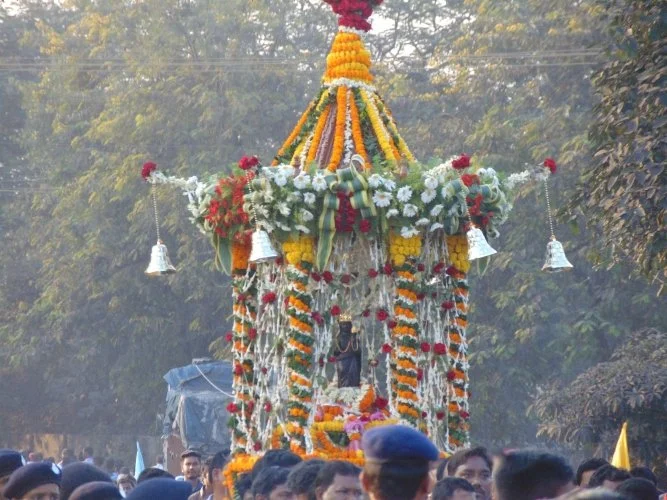
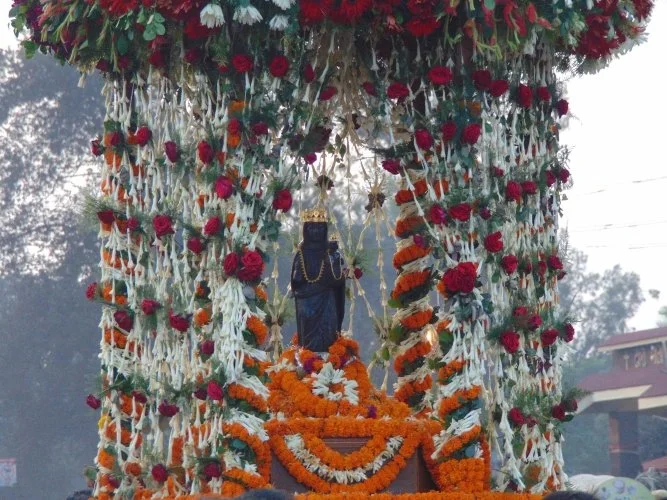
Big crowds of devotees of all the local religions attend the annual 9-day festival that concludes with the Missa Puja on the last Sunday of October. To Hindus, the divine mother has many faces. Why not a Christian one? And since the Virgin Mary is greatly praised in the Koran, many Muslims honor and pray to miraculous images of her as well.
The shrine is so famous that it was listed on the official tourist map of Jharkhand state.
Footnotes:
[i] A famous example is the self-arising statue of Tara in Pharping, Nepal. https://www.reddit.com/r/TibetanBuddhism/comments/1binkg2/a_selfarising_image_of_arya_tara_that_has_been/
[ii] https://paharistudent.com/a-historical-account-of-bilaspur-district/
[iii] The Legend of Kali and Baby Shiva: After defeating demons, Kali's bloodlust became so intense she threatened to destroy the universe. To stop her, Shiva lay down on the battlefield, appearing as a motionless corpse. Kali, in her rampage, stepped on Shiva's chest. Then, realizing it was her husband, she was overcome with shame, stuck out her tongue, and her rage subsided. In some versions, Shiva transforms into a crying baby after this, prompting her maternal instincts to fully emerge, stopping her destructive path and restoring balance.
Other Sources:
https://en.wikipedia.org/wiki/Dhori_Mata_Tirthalaya
https://www.catholicsandcultures.org/india-history-dhori-mata-shrine
https://paharistudent.com/a-historical-account-of-bilaspur-district/