Plancoët, France
Notre Dame de Nazareth
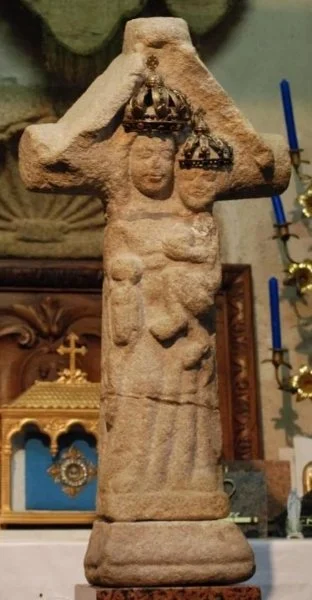
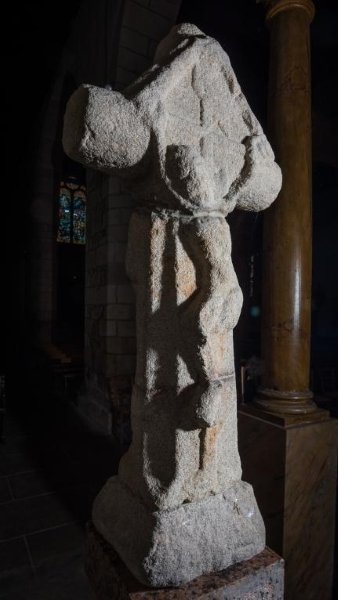
In her own church built for her and bearing her name, 107 Rue de l'Abbaye, 22130 Plancoët, Brittany, Côtes-d'Armor, medieval, recovered October 18, 1644, a gray granite monument cross. One side depicts the Virgin and Child, with a third, small, unidentified figure next to the Virgin (maybe John the Baptist), the other side Christ on the cross. In the context of the modern discussion of Mary’s title ‘co-redemptrix’, it’s significant to note ancient crosses that depict the Crucified redeemer on one side and his mother, the co-redeemer on the other.
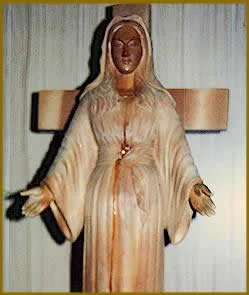
Although Our Lady of Nazareth is not a Black Madonna, she is so powerful and shares so many Black Madonna leitmotifs that I just had to include her in this index. Like some other Black Madonnas, she isn’t just a statue, but actually an apparition of the Virgin Mary. This is an issue that took me a long time to understand. I was often confused when there was talk of the apparition of a Black Madonna. What we are dealing with here is the fact that the divine Mother appears in and through statues, communicates through them. A good example is Our Lady of Akita in Japan. In 1973 Our Lady entered an existing statue of herself in that town. From there she spoke, emitted light, shed tears and bled. These events were officially accredited by the Church as an apparition of Mary.
In the same way, Our Lady of Nazareth in Plancoët has been officially accredited as an apparition of Mother Mary and she gave miraculous healing powers to a well. Plenty of reason to go to her on pilgrimage, especially since she sits smack in the middle between the Black Madonnas of Guingamp and Mont-Saint-Michel, only one hour from each of them!
Her story begins with a well built by the Knights Templar in the Middle Ages.
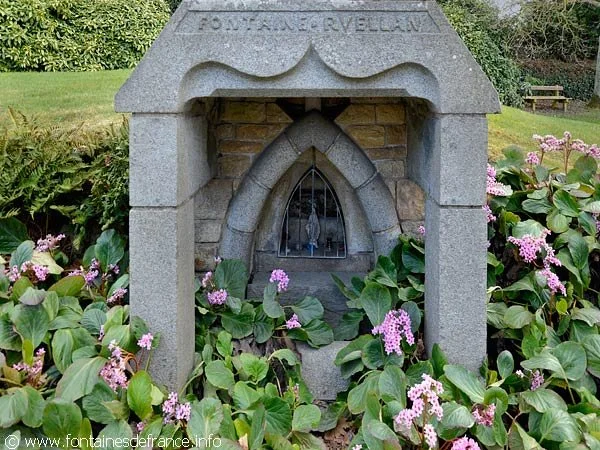
Centuries after its construction, a stonemason, needing water for a building site, tasked his employees with cleaning the Ruellan well – a deep, muddy spring teeming with aquatic plants. They discovered three hewn granite fragments from an old, broken cross. The pieces were reassembled and placed back on their base at the top of the fountain. A few weeks later, a mentally challenged man, Gilles Portier, threw it back into the fountain. Locals tried to recover the fragments, but in vain.
From then on, strange phenomena began to occur at the fountain, e.g. brilliant lights emerging from the water in the dead of night.
In May 1644, Olive Blandin, the 66-year-old widow of Yvon Bertin, from the village of La Massonnais in Corseul, was driving her flock near the Ruellan fountain. Four times, around ten o'clock in the morning, she heard a plaintive voice. Looking around, she saw no one. A thought then came to her: she told herself that her daughter, who had recently died, was suffering in purgatory and asking for prayers. Without hesitation, she knelt by the roadside and begged the Lord to have mercy on the soul of her poor child.
When she returned to Plancoët and recounted what had happened, people started talking and testifying. François Billy, a merchant living in Haut-Plancoët, said that while passing near the Ruellan well on July 26, 1643, the feast day of Saint Anne, he stopped to water his horse. Suddenly, he heard a loud voice—a woman's voice—uttering a lament. A quick glance around convinced him that he was alone at that spot on the road. He walked away, shaken, without understanding the source of the lament.
Nicolas Le Marchand, from Dinan, recounted that the previous year, in November 1642, returning from a fair held in the town of Matignon, he witnessed a similar phenomenon. As he passed near the Ruellan well at daybreak, he unbridled his horse to water it, but he couldn't get it to drink. He pressed its head to incline it towards the water and plunged its mouth into the stone basin, but in vain: the animal refused and fell to its knees. Annoyed, its master struck it a sharp blow with his whip. All for naught! The animal didn't move, but a moving cry rose from the fountain, stirring Nicolas Le Marchand's heart.
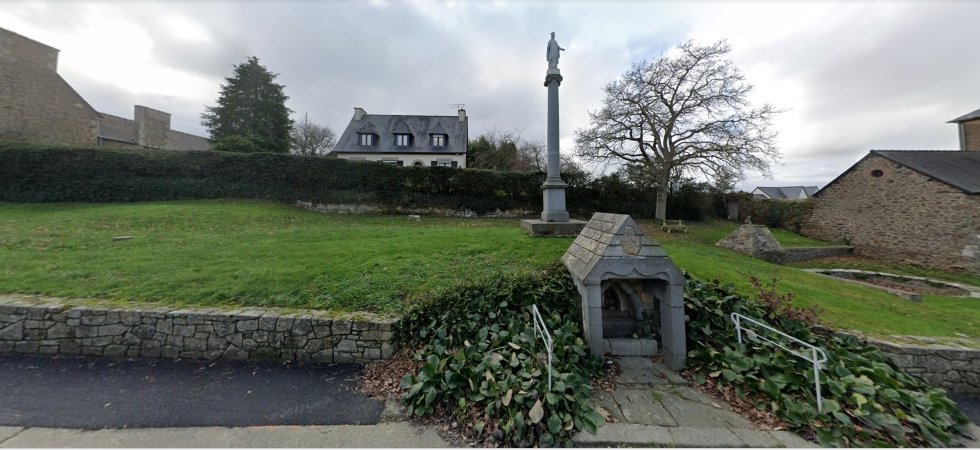
Hearing all these stories, the three sons of a hardware merchant from Bas-Plancoët, named Alain, Jacques, and Jean Faguet, aged 21, 19, and 17 respectively, determined to get to the bottom of it, decided to search the well. The day after the Feast of the Holy Rosary, Monday, October 3, 1644, Alain and Jacques began the task, but after working until two or three in the afternoon, the eldest became discouraged. More tenacious, the youngest discovered the first piece of the statue. He called back his brother, who was already walking away, and handed him the rest of the statue. Soon, Alain joined them, and Jean passed to his two brothers the piece bearing the heads of the Virgin and Child. Searching further, Jacques noticed the third piece at the bottom of the well—the pedestal (or base)—which seemed too heavy to lift, so he left it in the basin. Together, the three brothers washed the two pieces they had retrieved from the water and placed them on the bank of a field called Surset-Jacques, against an oak tree belonging to the lord of Laudren Le Roy.
The very next day, at daybreak, in a spontaneous display of piety, pilgrims flocked to the statue that had been calling from the deep to pray and leave offerings. Then, bowing respectfully, they devoutly drank the clear water of the cleansed well, where Mary's smile seemed to be reflected.
Astonishing signs then multiplied around the statue, beginning with rays of light, attested to by hundreds of witnesses. This was the case for Jean Lhostellier, aged 38, who was walking along the Rue de l'Abbaye shortly after midnight, climbing the hill towards Dinan. As he approached the leafy chapel, a bright light appeared to him, like that of a burning torch. Then the light disappeared.
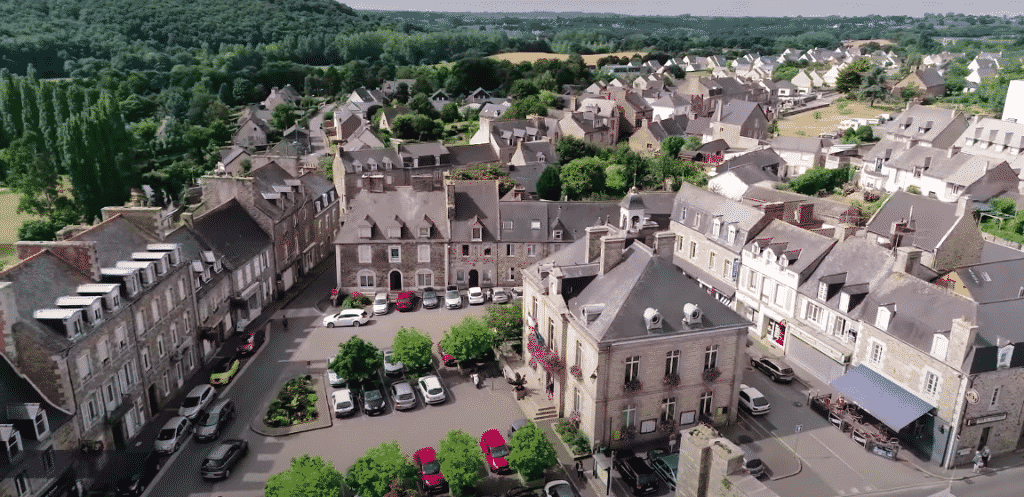
The town’s center with city hall
More people flocked to Plancoët. On October 18, 1644, a small group left the heights of Créhen three hours before dawn. It included a farmer, Yvon Merdrignac; a shoemaker, Jean Girard; a butcher, Guillaume Bouexière, and his wife, Jeanne Besrée, from the village of La Chesnelaye; and a certain Yves Gillebert who had joined them with his daughter. They approached the chapel two hours before dawn, in the dead of night. What a surprise! They saw in the middle of the road a beautiful, luminous lady, all dressed in white. By the time they reached the fountain, the lady had disappeared, and the road was deserted. All six knelt before the granite statue and, after praying for a long time, they entered a small hut on the other side of the road to eat breakfast, sheltered from the morning air. While they were eating, they saw a long flash of lightning and a brightness above the holy image, without hearing any sound of thunder.
Many others also observed a lady dressed in white, and so the number of pilgrims multiplied quickly. There were also many healings. Among them, a merchant on Rue de l'Abbaye, Guillaume Huet. He had been bedridden since Pentecost and unable to get up since September. He prayed to the Virgin Mary, promising to go to the well if he could walk again. Instantly, his pain vanished, and he was able to walk once more. The next day, on his way back from Dinan, he and the Faguet brothers decided to build an oratory (a small wooden cabin) to collect votive offerings and house the statue.
The Church and Monastery
In November 1644, Bishop Achille de Harlay de Sancy of Saint-Malo ordered an investigation. (A copy of the original French text is available from https://gallica.bnf.fr/) For three days witnesses were questioned and then the bishop declared the phenomena to be of divine origin. The construction of a sanctuary was approved.
The Oratorians were the first to express interest in building a chapel, but Catherine de Rosemadec-Molac, Baroness of La Hunaudaye, wife of Guy de Rieux, Lord of Châteauneuf and owner of Plancoët, refused their request. On March 27, 1647, the Baroness instead gave permission to the Dominicans from Dinan to settled in Nazareth. She gave them the land and funds to build the chapel and monastery.
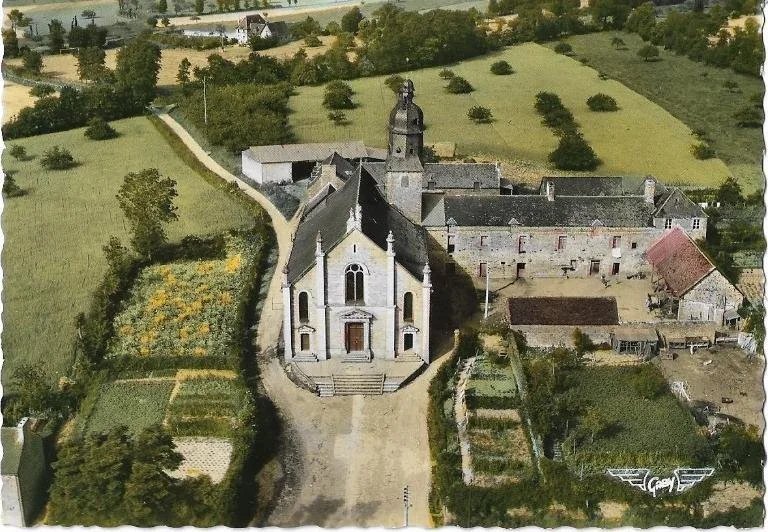
In 1648, King Louis XIV authorized the Dominicans' establishment, and the Parliament of Brittany ratified the king's decree on January 19, 1649. The blessed cornerstone was laid on May 2, 1649, in the presence of Ferdinand de Neufville, Bishop of Saint-Malo. On July 6, 1688, the Dominican foundation was officially established as a monastery. The monks were expelled during the French Revolution, but the desecrated church was returned to religious use in 1818 and extensively remodeled.
Since the beginning, popular devotion has not waned. There is still an annual pilgrimage (“pardon” in Brittany French) to Our Lady of Nazareth, who was canonically crowned on September 8, 1928 with the approval of a papal bull signed by Pope Pius XI.
Some critics have expressed surprise at the phenomena accompanying this apparition: moans seemingly emanating from beyond the grave, the appearance of a white lady, and naive votive offerings. All of this evokes certain traditional Breton legends related to death. Indeed, for a time, the Gaelic Church presided over the faith of the Bretons, as well as the Irish. However, the thoroughness of the investigation and the testimonies of dozens of witnesses, who did not know each other, attest to the seriousness of the phenomenon. The number of healings whose reality cannot be doubted demonstrates that the Virgin Mary, in harmony with Gaelic tradition, did not hesitate to appear in accordance with the prevailing sensibilities in 17th-century Brittany.
Sources:
https://www.fontainesdefrance.info/fontaines/la-fontaine-ruellan/
https://codexdei.mariedenazareth.com/1000-raisons-de-croire/147/notre-dame-de-nazareth-a-plancoet-1644
https://patrimoine.bzh/gertrude-diffusion/dossier/IM22025185
https://www.cirkwi.com/fr/point-interet/118317-l-eglise-notre-dame-de-nazareth
https://patrimoine.bzh/gertrude-diffusion/dossier/IA22132232
Digging deeper:
A French, passionate account and commentary by Arnaud Dumouch: The apparition of Our Lady of Nazareth of Plancoët .
Article from the Marian Encyclopedia " Plancoët: Our Lady of Nazareth ".